Historically speaking, most artists have felt the pull to move to “the big city” to find inspiration and opportunity, and to be among other like-minded souls. Iconic locales like New York City, San Francisco and Los Angeles have been hotbeds for creative types for over a century. It’s easy to see how dynamic cities like these could inspire an artist’s entire career but, more often than not, the city itself becomes the muse.
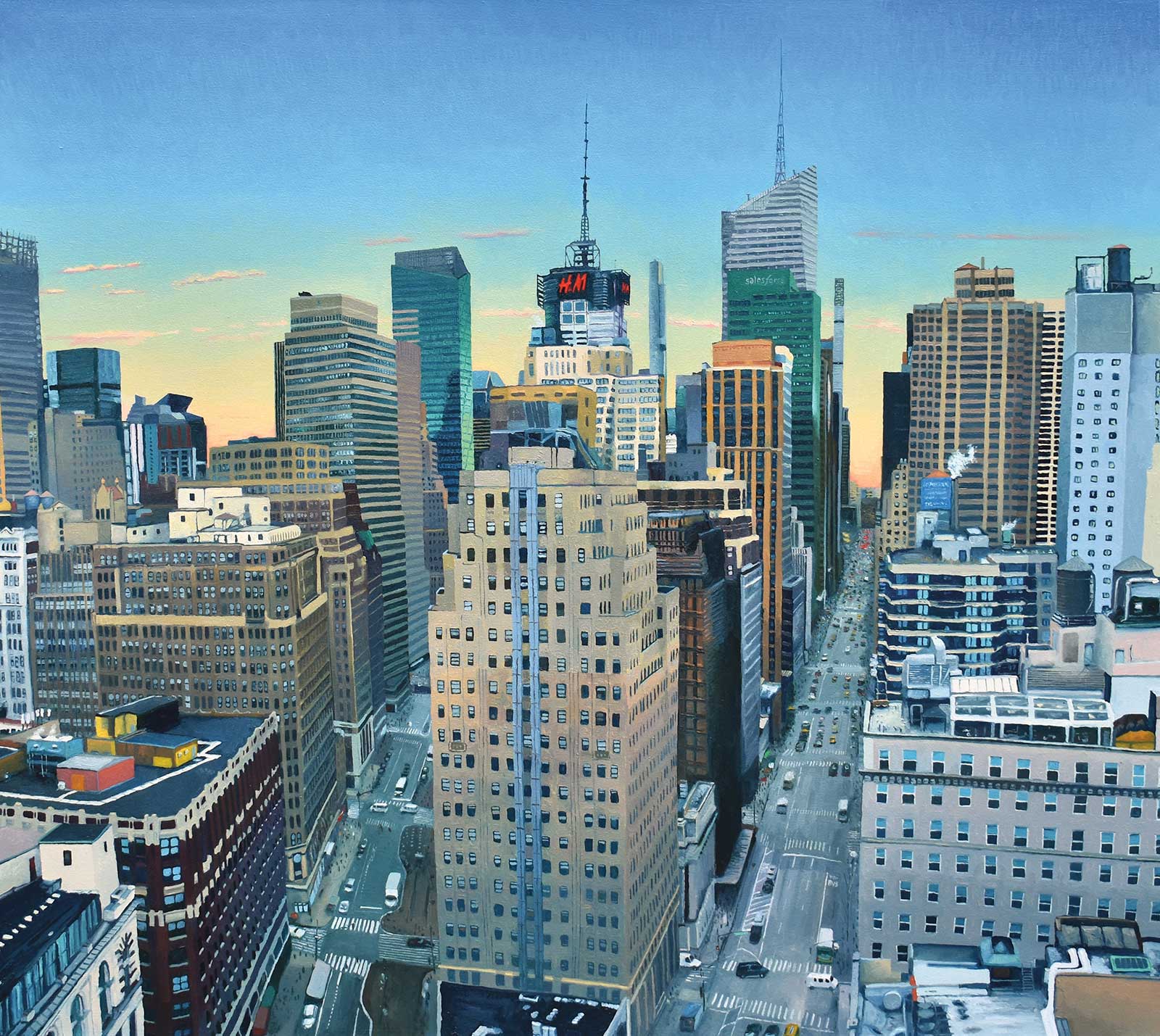
George Billis Gallery, Morning Coffee, oil on canvas, 45 x 40”, by David Leonard.
For anyone that’s lived in or visited a large metropolis, you know it can be a struggle to find even a modicum of beauty among the chaos, litter or graffiti. But within every “concrete jungle,” there are endless nooks and crannies to discover, and a new perspective or experience waiting around every corner—and sometimes all it takes is an artist to bring it all into focus.
Consider artists like Stephen Magsig, who relies on direct observation and photographic reference for his realist industrial landscapes of Detroit and New York cityscapes. Featured in the 2024 summer exhibition Industrial Beauty: Paintings from George Billis Gallery at the Fairfield Museum and History Center, Magsig’s painting, Espresso Bar, is a fine example of his impressive eye for finding and providing a new perspective of city life.
“Magsig looks for crucial details in both the highlights and the shadows, in the brightness and obscurity of each scene,” says gallery owner George Billis. "New Yorkers will recognize many of the scenes Magsig paints, yet the universal appeal is the atmosphere and mood which attracts those for whom the images hold no personal significance.”
The artist shares, “I get caught up in the mix of organic and non-organic human signs: the color of loaves of bread in an Italian bakery window, the reflections of facades in the car’s windshield, the abstracted angles of cornices and architectural detail.”
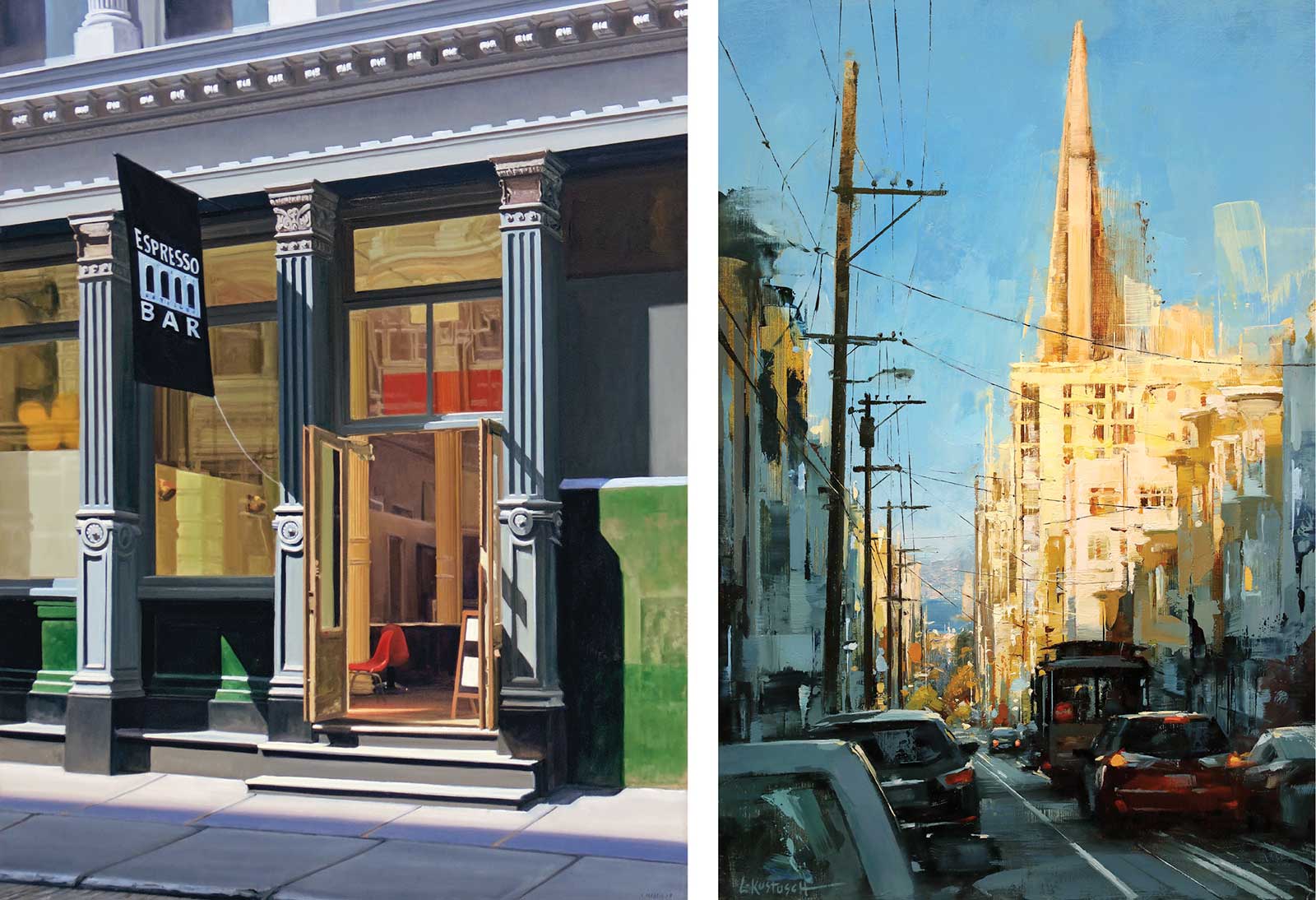
George Billis Gallery, Espresso Bar, oil on canvas, 62 x 48”, by Stephen Magsig; Principle Gallery, Afternoon Streetcar, oil on panel, 18 x 12”, by Lindsey Kustusch.
While Magsig focuses on details, another Industrial Beauty artist, David Leonard, is inspired and informed by the grids, patterns and rhythms of the city streets, as in his painting Morning Coffee, a New York skyline scene. “I’m drawn to the deliberateness of the skyscrapers and townhouses as if these architectural forms are my bottles, boxes and vases like in a Giorgio Morandi still life painting,” says the artist.
Leonard pays close attention to the elements in the atmosphere, like ash, cinder and soot, and their effect on the quality of the light and how it illuminates surfaces in a way that is unique to that particular place. “To leave this out would not be true to the people who live and have lived there, who may find their particular climate reassuring,” he says.
Another contemporary cityscape artist, Lindsey Kustusch, set her sights on San Francisco for a show at Principle Gallery this past November. “At 19, I moved to San Francisco from the Midwest, and it shook my entire world,” she shares. From the culture to the landscape itself, I saw the beauty in the city for the first time, and I made it my goal to capture it. Since then, I’ve explored many other subjects, but always come back to the urban landscape.”
Because this was a joint show with her husband, artist Nate Ross, revisiting the city seemed like the perfect theme. “We met at art school in San Francisco more than 20 years ago, and lived all over the world traveling, working, painting and inspiring each other to make art every single day,” Kustusch adds.
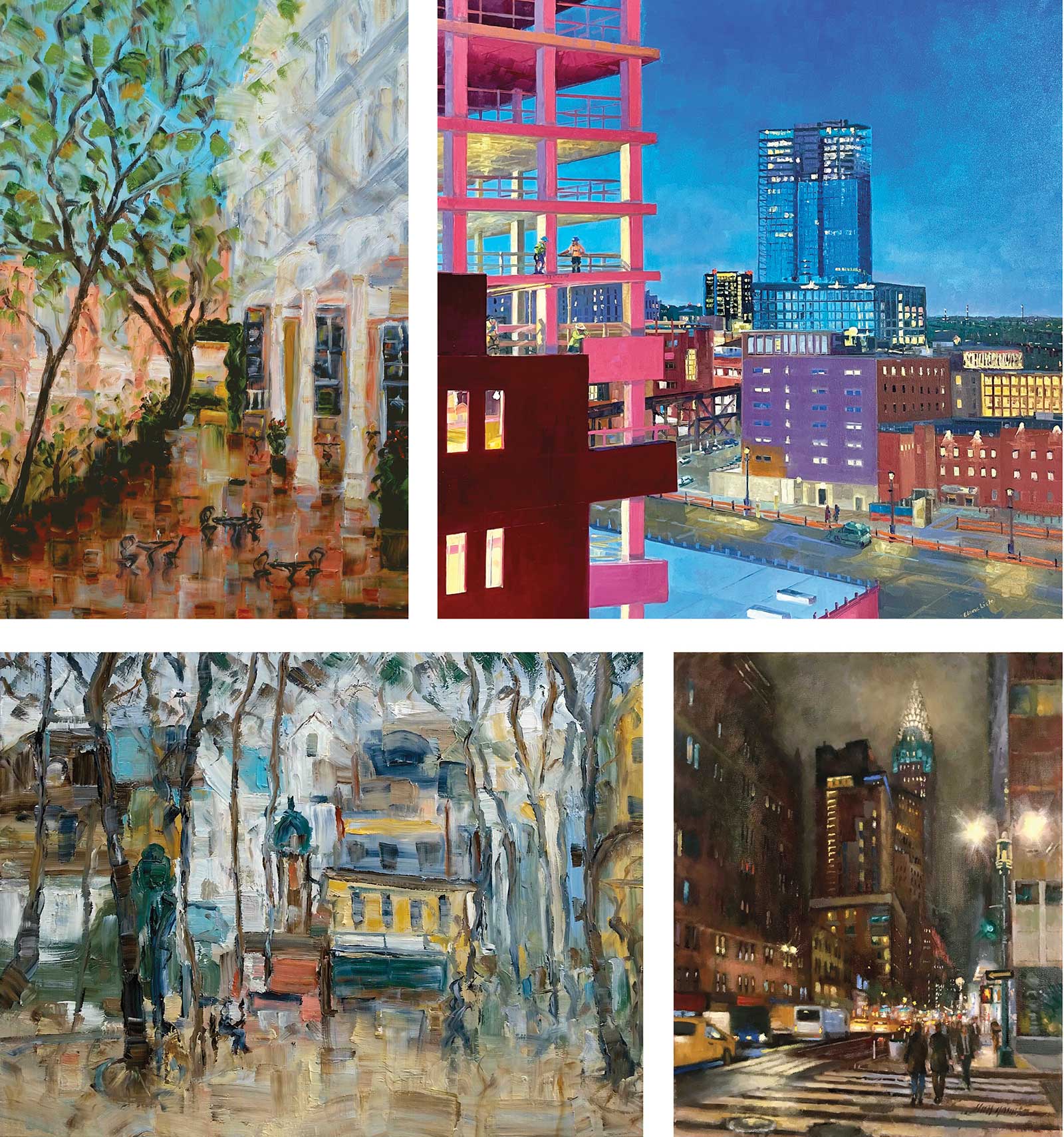
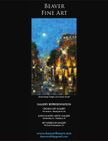
Top: Tommy Beaver, Downtown Courtyard, oil, 40 x 30”; Elaine Lisle, Working Late, oil on canvas, 36 x 36” Bottom: Tommy Beaver, French Quarter District Afternoon, oil, 18 x 24”; Hall Groat II, Chrysler Building, oil on canvas, 20 x 16”
In her painting Afternoon Streetcar, the artist captures the city’s hustle and bustle—a theme she has become known for—rather than isolated, quiet moments. Discussing Kustusch’s work, Taylor Chauncey, Principle Gallery assistant director notes, “I think the best cityscapes are done by combining sharp, clean strokes and looser, abstract elements to truly represent the grit and motion of city life. Your eye can’t always focus on one thing, there is constant stimulation.”
To hear more insights from painters of the urban landscape, and galleries that feature thier artwork, continue reading this special section dedicated to the genre.
Artist Tommy Beaver specializes in cityscapes with a focus on Downtown Charleston, South Carolina, among other various cities and towns. In paintings like Downtown Courtyard and French Quarter District Afternoon, we see Beaver’s impressionistic style come to life. He uses a large brush and sometimes a pallette knife to achieve the affect he desires. He strives to get the right colors and light balance as well. He relies on deep, rich tones, paying special attention to shadow. Beaver also takes most of his reference photos in the early morning or late afternoon when shadows are at their longest.
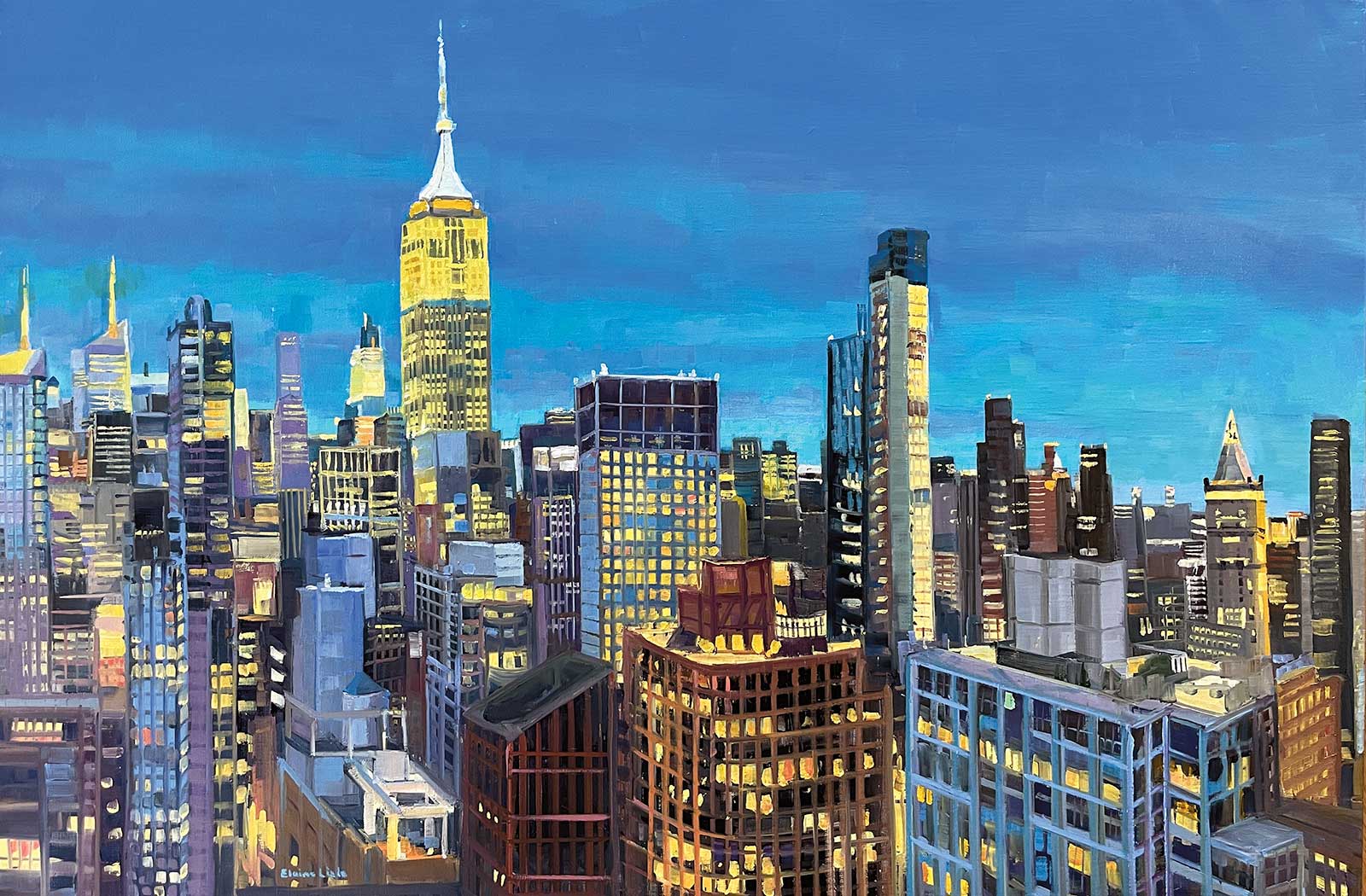
Elaine Lisle, Jewel of the City, oil on canvas, 24 x 30”
Find more work by this artist at Crown Art Gallery in Blowing Rock, North Carolina; Lowcountry Artist Gallery in Charleston; and Art Harbor Gallery in Georgetown, South Carolina.
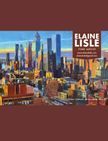
Elaine Lisle’s urban works are intricate compositions that convey the complexity and structure of the city. “I have been mesmerized by what happens to urban vistas as the sun goes down and the late afternoon warm hues move to the cooler artificial light of the night,” she says. “In the past, my city paintings have been primarily from a street-level perspective, often with people as focal points. There is still a lot of human activity in my newer paintings but in some cases, it is represented by vehicles and lit-up buildings rather than actual figures.” She adds that her process frequently starts with plein air sketches, then works on larger pieces in the studio.
When collecting the genre, Lisle suggests that you choose what you love. “Choose art that surprises you, something that invites you to keep looking,” she says. “If it doesn’t speak to you, it shouldn’t be on your wall.”
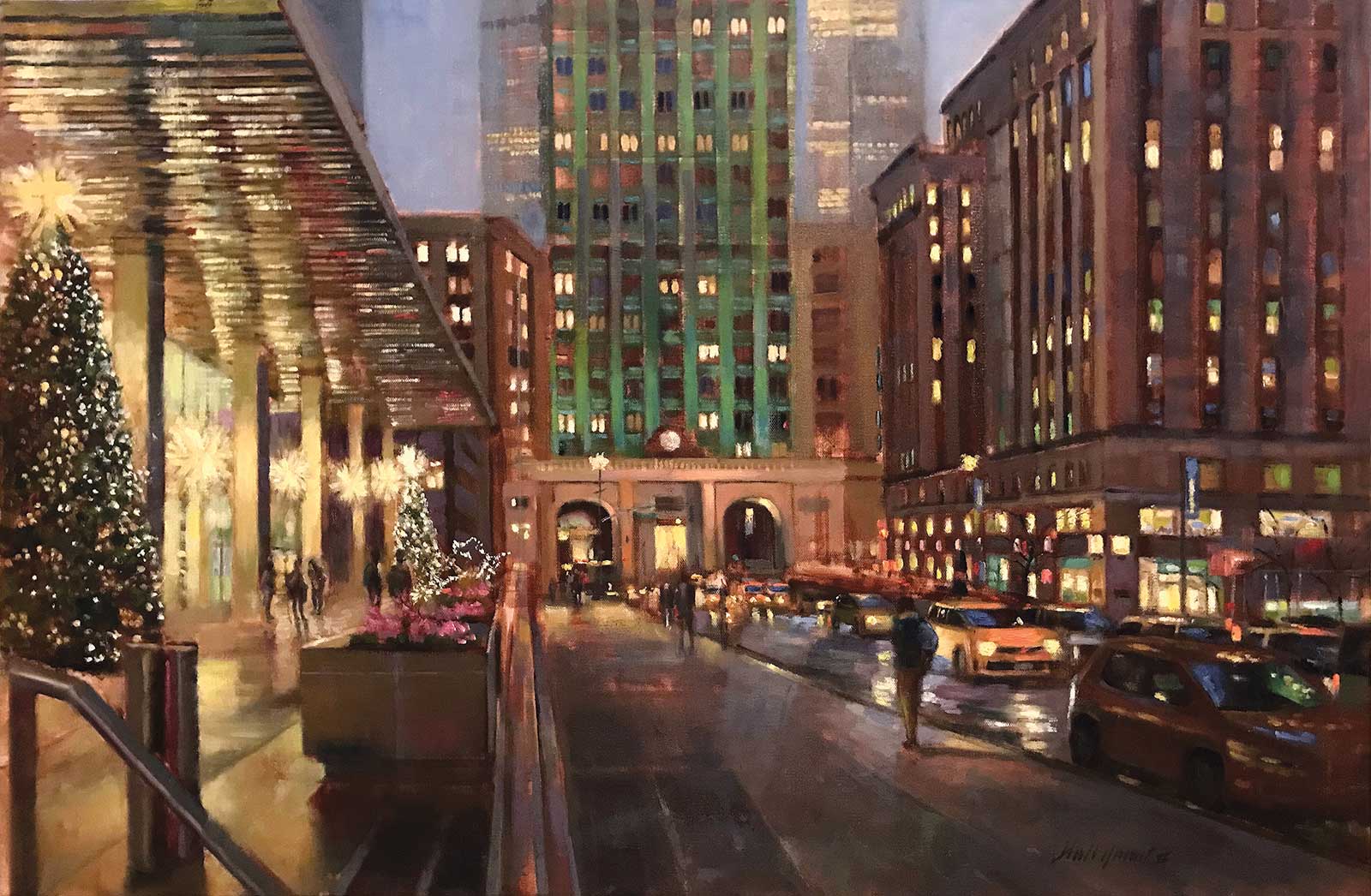
Hall Groat II, Christmas on Park Avenue, oil on canvas, 24 x 36”
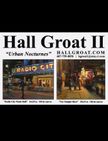
It was during a walk on a cold December night in Manhattan from St. Patrick’s Cathedral to Sparks Steak House, where artist Hall Groat II was inspired to create two nocturnal urban compositions: Christmas on Park Avenue and Chrysler Building. “The interplay of the luminous Christmas lights with the rhythmic movement of pedestrians, street vendors and automobiles expressed the holiday spirit,” Groat says. “The Helmsley Building with the two stately tunnels and the Art Deco spire of the Chrysler Building illuminating the romantic night sky were equally inspiring. It was many years ago while attending the graduate painting program at Brooklyn College where I was initially drawn to painting city views of Brooklyn from my studio window.”
The artist’s advice to collectors “is to collect pieces that contain subjects that you have personal connections with; ones that evoke fond memories or enable you to share stories.” —
Featured Artists & Galleries
Elaine Lisle
Bryn Mawr, PA
elainelisle@gmail.com
www.elainelisle.com
George Billis Gallery
527 W. 23rd Street, New York, NY 10011
(917) 273-8621 www.georgebillis.com
Hall Groat II
Endwell, NY, (607) 759-0058
www.hallgroat.com
Lindsey Kustusch
www.lindseykustusch.com
Principle Gallery
208 King Street, Alexandria, VA 22314
(703) 739-9326 www.principlegallery.com
Tommy Beaver
(336) 466-1885
tbeaver676@gmail.com
www.beaverfineart.com
Powered by Froala Editor